
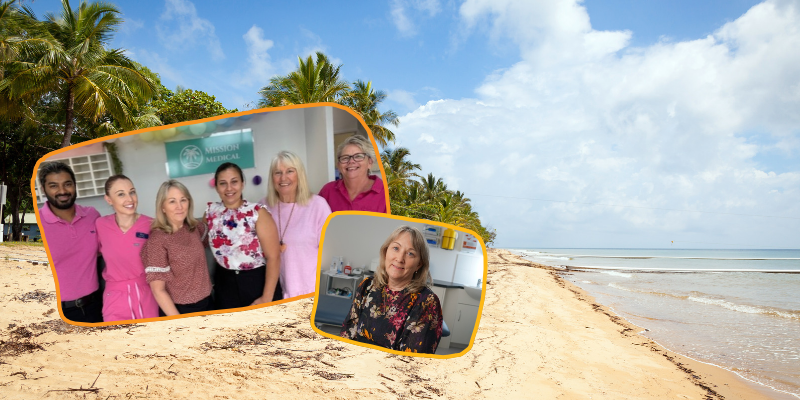
Communities in Mission Beach and Cardwell are accessing reliable, high-quality healthcare close to home, following the success of Northern Queensland Primary Health Network’s (NQPHN) Thin Markets Program.
Designed to support communities where traditional healthcare markets struggle to operate, the program has played a critical role in restoring and stabilising general practice services across the Cassowary Coast, delivering real, tangible outcomes for residents who had previously faced significant barriers to care.
At the centre of this success has been the re-establishment of Mission Medical, which opened in November 2024 after Mission Beach went without a local GP for three years following the closure of its previous practice.
In Cardwell, the program has supported the transition to a stable, locally owned general practice model, improving access and continuity of care for the community.
Since opening, the practices have experienced strong and sustained demand, reflecting the level of unmet need that had built up across the region.
Mission Medical has delivered more than 18,652 patient appointments over 12 months, while Cardwell Medical Practice recorded more than 8,084 appointments in 12 months.
For residents, the impact has been immediate and significant. Where people once had to travel long distances, often more than 30-60km, to access basic healthcare, now they see a GP in their own community and often on the same day.
Dr Kim Favier, owner and principal GP of both Tully Medical Centre and Mission Medical, said the return of local services had made a profound difference to the community.
“Mission Medical was established under the Thin Markets initiative to address healthcare service gaps in underserviced regions,” Dr Favier said.
“Prior to our opening, Mission Beach was without a local GP for three years. Our goal was to restore essential primary care services to the community and improve health outcomes through accessible, high-quality care.”
Dr Favier said the response from the community had been overwhelmingly positive, particularly among those most vulnerable.
“The return of local GP services has been met with strong community support and has had a significant positive impact,” she said.
“The practice has been particularly beneficial for elderly residents, individuals without access to transport, and patients with chronic and complex health needs. Many have expressed relief and gratitude for the return of local healthcare services.”
Beyond restoring access, the Thin Markets Program has enabled both practices to deliver a broader, more coordinated model of care, including chronic disease management, preventative health programs, telehealth, and visiting allied health services.
Mission Medical also achieved RACGP accreditation, reflecting its commitment to high standards of clinical governance and patient care, while Cardwell Medical Practice is progressing towards the same benchmark.
The program has also been instrumental in building a more sustainable healthcare workforce in the region. Mission Medical now operates with a stable GP workforce supported by strong nursing and administrative teams, while Cardwell Medical Practice has strengthened its clinical leadership and is improving workforce stability with ongoing support.
Dr Favier said the success of Mission Medical would not have been possible without the partnerships established through the Thin Markets Initiative.
“The initiative provided critical financial assistance for start-up costs and operational overheads during our first year,” she said.
“NQPHN provided targeted funding and strategic guidance, while Cassowary Coast Regional Council supported us with premises and rent assistance.
“These partnerships helped us overcome key challenges, including securing a suitable site, procuring equipment and recruiting staff.”
The program has also enhanced the ability of practices to manage long-term health conditions locally, reducing pressure on hospitals and improving patient outcomes.
“Mission Medical’s inclusion in the Chronic Conditions program has significantly enhanced our capacity to manage long-term health conditions,” Dr Favier said.
“We’ve been able to invest in specialised equipment, increase staffing, and deliver GP-led chronic condition management plans at no cost to patients.
“This has enabled more proactive and preventative care, reducing the burden on emergency services and improving quality of life.”
As the program transitions to business-as-usual, NQPHN will remain actively involved to help sustain these gains and support ongoing service development.
Dr Favier said the focus was now building on the strong foundation to ensure long-term sustainability.
“We continue to actively recruit general practitioners and allied health professionals to expand our service offerings,” she said.
“Our priorities include strengthening chronic disease management, enhancing multidisciplinary care, and building sustainable workforce models to ensure long-term service continuity.”