
Refugee Health QI Toolkit
Table of Contents
The refugee health QI toolkit
A practical companion to the NQPHN Foundational QI Toolkit. It supports general practice teams across northern Queensland to reduce gaps in refugee health access and outcomes, strengthen refugee-responsive care, and deliver culturally safe care for newly arrived and established refugee-background patients.
What this toolkit can help practices do
The activities in this toolkit are designed to support practical improvements that make refugee-responsive care easier to deliver and easier to sustain within routine general practice workflows.
Depending on the activities selected, practices may use the toolkit to:
- identify patients from refugee backgrounds more reliably
- reduce missed follow-up and improve continuity of care
- plan interpreter-supported appointments earlier
- support longer or staged consultations for complex needs
- reduce duplicated administrative work and avoidable rework
- improve coordination between reception, nursing and clinical staff
- strengthen recall, communication and follow-up processes
- support documentation of quality improvement activity for PIP QI, accreditation or CPD purposes
- identify appropriate MBS billing opportunities where eligibility requirements are met
- Key clinical resource
This toolkit should be used alongside the Australian Refugee Health Practice Guide, which provides detailed clinical guidance for the assessment and ongoing care of people from refugee backgrounds, including people seeking asylum.
The Guide includes practical guidance on:
- refugee health assessments
- screening and immunisation
- mental health considerations
- common health conditions
- referral pathways
- culturally responsive care
This toolkit complements the Guide by focusing on practice systems, workflows, follow-up, communication and quality improvement activities that support refugee-responsive care in general practice settings.
How to use this toolkit
The toolkit is split into two streams. The first builds understanding of the QI process and the local refugee health context. The second applies that understanding to guide practical change activities. A list of references and external tools that may support understanding and improvement activities is provided in the appendices.
Stream A
Building understanding and readiness
Introduces the foundations of refugee-responsive care and supports practices to build understanding, readiness, and shared QI approaches across the practice team. Use it to identify priorities, build team engagement, and develop confidence before testing changes in practice.
Stream B
Taking action and driving improvement
Helps practices make practical improvements to refugee-responsive care. Choose a pathway matching current capacity, select one focus area, and pick one or more activities to begin with. Activities are grouped into Quick Start, Core, and Stretch pathways across four refugee health focus areas.
The five-step guide below shows how Stream B fits together. Most practices start with one focus area and a small number of activities, test changes, and build from there.
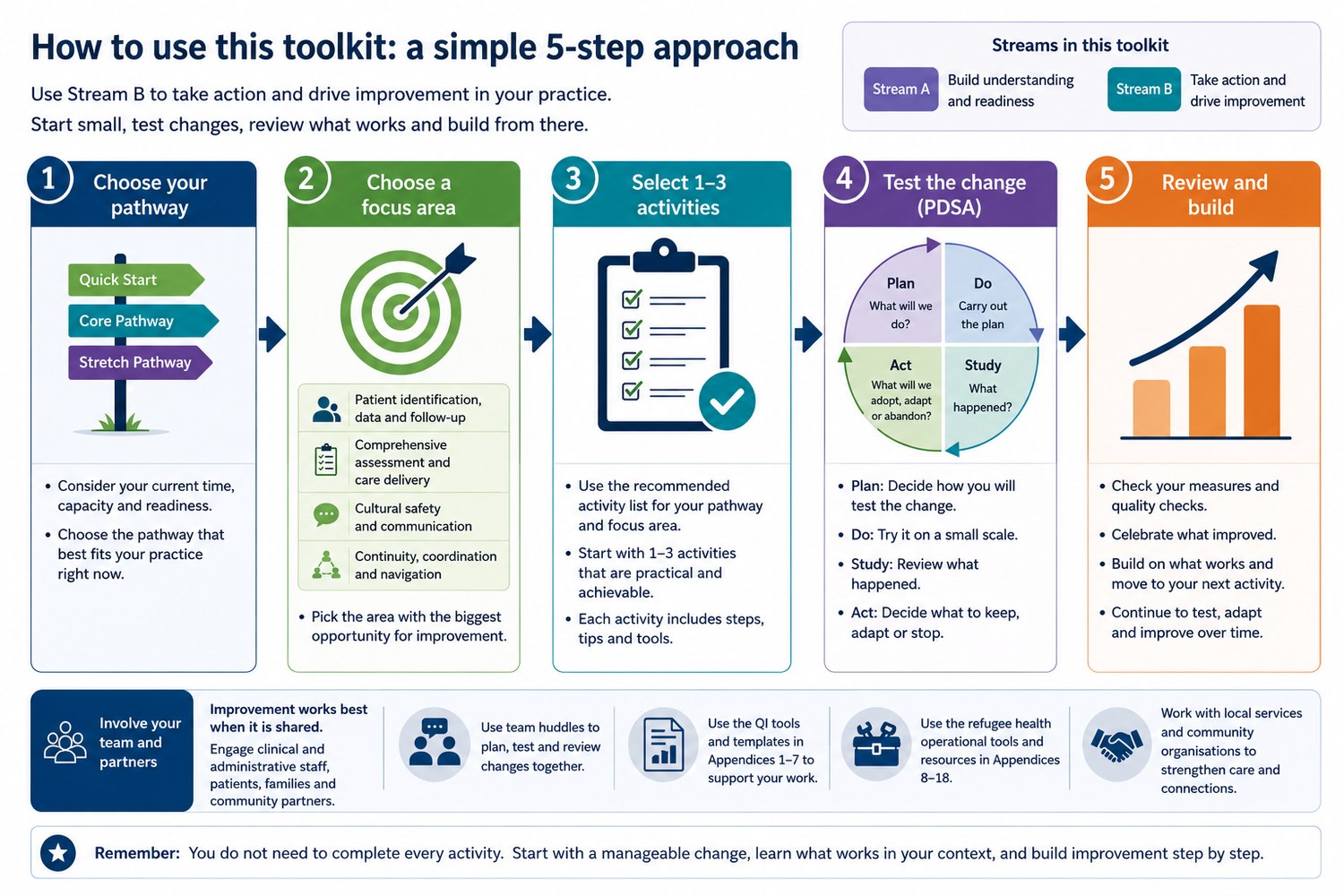
Practices do not need to complete every activity. Start small, test changes, review what is working, and build progressively over time.
Stream A
Building understanding and readiness
The foundations of refugee-responsive care, the local context, and the QI concepts that underpin the activities in Stream B.
Section 01
Introduction to refugee health quality improvement
Why refugee health?
People from refugee backgrounds often arrive with complex physical, psychological and social health needs. Primary care may need to address migration history, communicable disease screening, catch-up immunisation, chronic disease, women’s and child health, mental health, trauma, oral health, and social determinants of health within standard GP consultation models. Without structured tools and coordinated support, variation in care is likely. Screening outcomes can differ between services, patient follow-up can lapse, mental health needs can go unrecognised, and refugee status may not be captured consistently in practice data.
Why northern Queensland?
Townsville and surrounding areas of northern Queensland are already operating in a pressured health system. General practices, hospitals, community services and settlement organisations are working within constraints that include workforce shortages, funding limitations, high service demand, transport barriers, and existing inequities for priority populations.
Recent refugee arrivals to the region have been concentrated among specific cohorts, including people from the Central African Republic and Sango-speaking communities, where locally tailored services, particularly translation and interpreting support, are very limited.
Why was this toolkit developed?
Quality improvement can address these challenges by providing tools to improve workflows, data systems and staff roles, rather than relying on individual clinicians or practice staff to do more. Engagement work has revealed strong enablers, such as the Multicultural Liaison Officer at Townsville Hospital, QPASTT bicultural workers and existing community trust, that QI initiatives can build upon. By completing the activities presented in this QI toolkit we can work towards closing the equity gap and ensure refugees receive consistent, culturally informed care and create better health outcomes.
- What this toolkit will not do
This toolkit does not replace clinical guidelines, local referral advice, professional judgement, or the existing high-quality refugee health resources already available to general practice. It does not provide detailed clinical management guidance for individual conditions, prescribe treatment pathways, or cover the management of urgent clinical events, mental health crises, safeguarding concerns, or complex case-specific decisions.
Section 02
Understanding your patient population
Good refugee health QI starts with understanding your refugee patients. That means knowing which patients are from refugee backgrounds, which patients are newly arrived, what their interpreter needs are, and which patients have incomplete assessments, screening, immunisation, referrals or follow-up.
Diversity of refugee communities in northern Queensland
Townsville is home to a significant refugee population, with the largest arrival groups from the Central African Republic and the Democratic Republic of Congo, and smaller numbers from Burundi, Cambodia, Cameroon, Ethiopia, Myanmar, Afghanistan, Iran, Somalia, South Sudan and Sudan. This local profile matters for general practice. Refugee patients may come from different countries, language groups, migration pathways and settlement circumstances. Each group has arrived under different circumstances and each group has differing prevalence of healthcare priorities.
Not every patient from a refugee background needs the same type of support. Once patients are visible in the system, practices may segment the population into groups. This helps the team decide what action is required and avoids assuming all refugee patients have the same health needs or journeys.
Useful patient groupings may include:
- Newly arrived patients who need an initial or on-arrival health assessment
- Patients with incomplete screening, pathology or immunisation catch-up
- Patients with active referrals but no recorded referral outcome
- Patients who missed their last appointment and have no future appointment booked
- Patients with interpreter needs not recorded or inconsistently recorded
- Patients with complex health, mental health or social needs requiring staged care
- Established refugee-background patients who need chronic disease, preventive health or mental health follow-up
Why equity, trust and timing matter for refugee-background patients
Clinical records can identify patients from a refugee background, but not always why gaps in care occur. For refugee health, three factors are important.
Equity
Refugee-background patients may be undercounted or underserved when refugee status, country of birth, language need or interpreter requirement is not recorded. Care gaps often reflect workflows that do not fit the patient’s needs, including interpreter scarcity, transport barriers, settlement pressures and lack of familiarity with the health system.
Trust
Patients are more likely to disclose concerns, attend follow-up and accept referrals when they feel respected, understand confidentiality and know why information is being collected. A culturally informed first encounter is therefore part of safe care.
Timing
Missed opportunities compound. If interpreter needs, support contacts or follow-up actions are not recorded early, assessments, referrals, results and recall can lapse. For limited-access languages, early planning is essential because same-day interpreter access may not be reliable.
Positive experiences matter
For people from refugee backgrounds, a culturally informed first encounter can shape whether existing health concerns are disclosed early and influence long-term health outcomes. A welcoming reception, visible interpreter access, respectful explanation of confidentiality, longer appointments where needed, and continuity with a trusted GP or nurse all help create the conditions in which patients unfamiliar with the Australian health system feel safe to speak and become more comfortable accessing the care they need.
- Key resources for refugee health care
The Australian Refugee Health Practice Guide should be used as the key clinical reference for this section. The Guide is designed for doctors, nurses and other primary care providers caring for people from refugee backgrounds, including people seeking asylum. It supports both on-arrival and ongoing care.
The Townsville refugee community and language quick guide is designed to help general practice teams create a respectful first encounter with patients from refugee backgrounds in Townsville and surrounding areas. It should be used alongside the Australian Refugee Health Practice Guide to support language recording, interpreter planning, culturally informed reception processes and links to translated resources.
Sango-speaking patients
- Practice tip · Sango-speaking patients
Some recent arrivals in Townsville, including people from the Central African Republic, speak Sango. Sango interpreter access is in short supply, and the language is primarily spoken rather than written.
Where relevant, practices should record:
- Whether Sango is required for clinical care
- Whether another language can be used, and in what format
- Whether that other language is suitable for administration only or for clinical discussion
- Confidentiality concerns, especially for patients from a small community group
- Failed Sango interpreter bookings
- Appointments delayed or rescheduled because no interpreter was available
The same approach should be used for any other language where professional interpreter access is limited, delayed or unreliable. The purpose is to make language-access risk visible so the practice can plan appointments, arrange interpreters earlier, involve support services appropriately, and avoid unsafe communication.
Section 03
Having difficult conversations in refugee health
What conversations may be difficult to have
Patients from refugee backgrounds may have experienced conflict, persecution, displacement, detention, deprivation, family separation, torture, sexual violence or prolonged immigration uncertainty. Some may also come from communities or circumstances where mental illness, trauma, chronic and communicable diseases (such as tuberculosis and HIV), reproductive health concerns, disability, child safety or family violence carry shame, fear or stigma. Safe medical history disclosures depend on clear confidentiality, trusted relationships, appropriate language support and a practical pathway for care.
Creating the conditions for disclosure
Health concerns, especially mental health, often surface well after initial settlement. Patients may be concerned that certain medical disclosures could affect their visa status or be shared with government, while the relief of arrival and the immediate work of housing, income, school, family and learning a new system can temporarily push trauma and distress into the background. As early settlement supports reduce and patients are expected to manage their own care, deferred physical and mental health needs may become more visible.
Creating the conditions for disclosure requires time: enough appointment time to raise sensitive issues safely, enough relationship time for trust to develop, and enough planning time to arrange appropriate language support. For limited-access languages such as Sango, early interpreter planning is especially important because a sensitive conversation may not be safe, informative or productive if an appropriate interpreter is unavailable. Disclosure builds across multiple encounters where each consultation strengthens trust and provides the opportunity for the patient to raise concerns when they are ready.
Interpreter realities and language-access risk
Interpreter access is a major safety consideration for patients from a refugee background, with interpreter shortage being one of the most consistent barriers. Most notably, scarcity of Sango interpreters presents a particularly acute challenge in northern Queensland: interpreters often need to be pre-booked, and may not be available if the patient arrives outside the booked appointment time. In small language communities, patients may also have concerns about confidentiality, interpreter familiarity or whether the interpreter can safely support a sensitive conversation.
When an appropriate interpreter is unavailable, practices may need to narrow the conversation to immediate needs and reschedule with language support. Any use of family members or informal supports, while often the only immediately available means of addressing interpreter shortage, should be recorded as a language-access gap so the practice can see where interpreter limitations are affecting safety, continuity and equity.
Explaining confidentiality, consent and why information is being collected
Sensitive questions can feel intrusive or unsafe when patients do not understand why information is being collected and who will see it. Practices should explain confidentiality and consent in plain language, translated where required, before asking. This task becomes significantly harder when interpreters are scarce because the explanation itself requires accurate language support and enough time for questions. For limited-access language groups, practices may need to separate urgent clinical care from sensitive questioning, arrange a better-supported follow-up appointment, and avoid relying on family members or informal supports for consent and confidentiality discussions wherever possible.
Cultural meanings, stigma and different explanations of distress
Patients may express distress through sleep problems, pain, tiredness, appetite changes, irritability, worry, family conflict, grief, spiritual concerns or difficulty managing daily life, rather than using terms such as “mental health”, “trauma”, “depression” or “anxiety”. The meaning attached to these terms will vary between patients, families and communities, and may be shaped by experiences of displacement, religion, gender roles, family expectations, community reputation and previous contact with health or government systems.
Section 04
Testing practical improvements
Quality improvement does not require large-scale redesign or major new programs. In most practices, improvement starts with identifying one small change, testing it in day-to-day workflow, and reviewing whether it made care easier, safer, or more consistent. Small tests of change help practices improve refugee-responsive care without overwhelming staff or disrupting normal operations.
For a detailed understanding of quality improvement fundamentals, see the NQPHN Foundational QI Toolkit.
The Model for Improvement
The Model for Improvement (MFI) asks three simple questions:
- What are we trying to improve?
Define a clear and practical goal. - How will we know a change is an improvement?
Identify a small number of measures or observations that indicate whether the change is helping. - What change can we test?
Choose one practical change idea that can be trialled on a small scale.
The activities in this toolkit and presented in Section 08 are designed to help practices answer these questions in practical ways.
| Question | Example |
|---|---|
| What are we trying to improve? | More patients requiring interpreters are identified before appointments |
| How will we know? | Reception staff can see interpreter needs when booking appointments |
| What change can we test? | Add preferred language and interpreter requirement to the registration workflow |
Using a PDSA cycle
Many practices use small Plan-Do-Study-Act (PDSA) cycles to test changes before introducing them more broadly.
- Plan: choose one small change to test and decide how progress will be observed.
- Do: test the change with a small number of patients, appointments or staff.
- Study: review what worked, what did not, and any unexpected issues.
- Act: decide whether to:
- adopt the change
- adapt the change and test again
- abandon the change and try a different approach
Most improvement work involves several small adjustments over time rather than one perfect solution.
- Practice tip · Start small and maintain momentum
Practices do not need to implement every activity in this toolkit at once. Starting with one or two practical changes is often more effective than attempting large-scale redesign immediately. Small improvements that fit into existing workflows are more likely to be sustained over time.
Sharing progress with the team can help maintain momentum. Small improvements are more likely to continue when teams can see results, reflect on what worked, and recognise staff contributions along the way.
Section 05
Practical tools to support improvement
This toolkit includes a set of practical templates, checklists and planning tools that practices can adapt to support refugee health improvement activities. The tools are designed to support practical implementation within routine general practice workflows and can be adapted to suit different practice sizes, systems and staffing models.
The activities in Section 08 identify which tools may be most useful for each improvement activity.
Planning and tracking tools
These tools help practices define improvement goals, identify priorities, plan activities and track progress over time. They are most useful when planning or reviewing an improvement activity.
| Tool | Purpose |
|---|---|
| Appendix 1: AIM Statement Template | Helps practices define a clear improvement goal |
| Appendix 2: Measures Template | Supports tracking of process and outcome measures |
| Appendix 3: Driver Diagram Template | Maps contributing factors and possible change ideas |
| Appendix 4: Problem Statement Template | Helps describe the issue, impact and contributing factors |
| Appendix 5: Cause and Effect Template (Fishbone) | Supports structured exploration of barriers and causes |
| Appendix 6: Model for Improvement Guidance | One-page reference guide for using the Model for Improvement |
| Appendix 7: MFI & PDSA Template | Supports planning, testing and reviewing small improvement activities |
| Appendix 16: Action Plan Template | Helps practices assign actions, responsibilities and timelines |
Workflow and coordination tools
These tools support patient follow-up, appointment planning, interpreter coordination and day-to-day team workflows. They are most useful when improving recall systems, interpreter workflows, appointment planning or continuity of care.
| Tool | Purpose |
|---|---|
| Appendix 8: Refugee Patient Register, Identification and Review Checklist | Supports patient identification, tracking and follow-up |
| Appendix 9: Monthly Snapshot Template | Supports regular review of refugee health activity and progress |
| Appendix 10: Team Huddle Template | Helps teams discuss workflow issues, risks and priorities |
| Appendix 11: SMS and Call/Recall Script Sheet | Supports consistent patient communication and follow-up |
| Appendix 12: Pre-Booking Workflow Template | Helps practices plan appointments, interpreter use and preparation |
| Appendix 15: Partnership Planning Template | Supports coordination and communication with external services and community organisations |
Cultural responsiveness and communication tools
These tools support culturally responsive care, communication and patient engagement. They are most useful when reviewing patient experience, communication approaches or culturally safe care practices.
| Tool | Purpose |
|---|---|
| Appendix 13: Flexible Access Strategy Planner | Supports planning for transport, appointment flexibility and access barriers |
| Appendix 14: Cultural Readiness Assessment | Helps practices reflect on culturally responsive systems and environments |
| Appendix 17: Steps to Having Difficult Conversations | Supports safe and respectful communication around sensitive issues |
Clinical support resources
These tools and resources support refugee health assessment, screening and ongoing care. They should be used alongside local referral pathways, clinical guidance and professional judgement.
| Tool / resource | Purpose |
|---|---|
| Appendix 18: Health Screen for Refugee Patient from the Central African Republic | Supports structured health assessment for a key local refugee cohort |
| Australian Refugee Health Practice Guide | Primary clinical reference for refugee health assessment and ongoing care |
| Victorian Refugee Health Network, Refugee Health Assessment Template | Structured assessment template for refugee health consultations |
Stream B
Taking action and driving improvement
Choose a pathway, select a focus area, and pick one or more activities to test in your practice. Most teams begin with three to five activities in a first improvement cycle.
Section 06
Choose your pathway
Practices across northern Queensland start refugee health QI from very different positions. Some have structured QI processes already in place. Others are new to systematic change or are balancing competing service demands. This toolkit offers three pathways so each team can begin where it is, with the time and capacity it has.
The Quick Start Pathway defines the minimum viable starting point, focusing on a small number of practical activities that establish the core systems for identifying and supporting patients from refugee backgrounds and create a foundation for further improvement. The Core Pathway builds on this foundation, supporting practices to scale improvement through more structured processes, including care delivery, follow-up, and communication. The Stretch Pathway extends this work further, embedding improvement into routine practice and supporting ongoing benefits for patients, staff, and services. The individual activities for each pathway are described in a step-by-step manner in Section 08.
The pathways are cumulative, but they are not a ladder you must climb. They are a practical way of mapping the scale and impact of the QI work to what the team can realistically sustain.
Quick Start Pathway
Approximate effort: around 2–4 hours per month
A practical entry point for practices beginning refugee health quality improvement activities. This pathway focuses on establishing the minimum systems needed to identify refugee patients, support communication needs, and improve continuity of care. It is designed for practices with limited time, limited QI experience, or those wanting to align refugee health activities with existing PIP QI work.
What is involved
Core Pathway
Approximate effort: four to six weeks of focused work
Designed for teams ready to embed refugee health improvement into broader systems of care. This pathway focuses on strengthening follow-up, communication, coordination, and culturally responsive care through structured quality improvement activities. Teams test practical changes, monitor what happens, and refine approaches over time to support more consistent and effective care delivery.
What is involved
- Activity 3: Generate and review refugee patient lists
- Activity 5: Conduct structured refugee health assessments
- Activity 6: Establish recall and follow-up processes after initial assessment
- Activity 9: Create a culturally safe and welcoming practice environment
- Activity 10: Establish a consistent interpreter workflow
Stretch Pathway
Approximate effort: ongoing effort, embedded in routine operations
Designed for practices seeking to embed refugee health improvement into long-term systems, workflows, and partnerships. This pathway focuses on sustaining improvement over time, strengthening coordination with external services, and adapting care models to better respond to complex or evolving patient needs. It supports practices to move beyond individual activities toward more integrated and routine approaches to refugee-responsive care.
What is involved
- A note on choosing
Pick the pathway that matches the team’s current capacity, not its ambition. A Quick Start done effectively outperforms a Stretch that stalls after three weeks. Teams can move up a pathway once the previous one is embedded. Most practices begin with a small number of Quick Start activities and build over time as systems and team confidence in QI activities develop.
Section 07
Identifying a refugee health focus area
Most practices begin with one focus area that reflects a visible workflow issue, patient need, or gap in follow-up or communication. Starting with one practical area is usually more effective than trying to improve multiple systems at once.
Practices may wish to focus on areas where patients are commonly lost to follow-up, interpreter or communication needs are inconsistently managed, refugee patients are difficult to identify in the clinical system, or staff experience recurring workflow challenges. Where possible, use available data and discussion across the practice team to help identify the most practical and achievable starting point.
Focus areas for refugee health
The focus areas below cover the most common and impactful refugee health improvement opportunities in general practice. They are not a checklist. Most practices pick one focus area for their first cycle and move to another once the first is embedded. The QI pathways described in Section 06 contain activities that span multiple, or all, of these focus areas.
Focus 01
Patient identification, data and follow-up
Ensure patients from refugee backgrounds are correctly identified, recorded, and visible in clinical systems.
Focus 02
Refugee health assessment and care delivery
Strengthen how initial assessments and ongoing care are delivered, particularly for patients with complex needs.
Focus 03
Cultural safety and communication
Focus 04
Continuity, coordination and navigation
Strengthen follow-up, clarify responsibility, and improve connections with external health and settlement services.
- Practice tip · What focus area to start with
Practices new to refugee health should start with Patient identification, data and follow-up activities, as improvement is difficult without knowing who the patients are. Once patients are visible in the system, move to Refugee health assessment and care delivery or Cultural safety and communication, where early gains in access and safety are often highly impactful. Practices with more established refugee health systems may begin with Continuity, coordination and navigation, particularly where patients are already being seen but are not progressing through care.
It is worth recognising that cultural safety work is sometimes treated as a later-stage or stretch activity, but for many patients it is perhaps the most impactful focus area, particularly where language barriers, trust, or prior experiences of the health system are affecting engagement and outcomes.
Section 08
Refugee health QI activities
This section sets out twelve concrete activities that make up the doing layer of refugee health QI in general practice. Each activity is a self-contained piece of work that a team can take on within a PDSA cycle, and is supported by the tools listed at the end of each block.
The pathways in Section 06 bundle these activities into sensible starting points based on practice capacity. The focus areas in Section 07 group the activities into key domains of refugee health care.
Activities are ordered by the typical sequence in which practices are suggested to undertake them within each focus area, from identification and data processes, through to care delivery, communication and coordination. However, a team does not need to do all twelve, or in the order that they are presented. Most practices work through three to five activities in any given improvement cycle.
If you would like to take a capacity-based approach to refugee health QI, you may decide to conduct the activities in the order that they are presented in their assigned Quick Start, Core or Stretch Pathway in Section 06. Alternatively, if you would like to pursue a defined thematic area for improvement, you may wish to tackle them in the order that they are presented in their assigned focus area as described in Section 07.
Most activities involve both clinical and administrative workflows and are generally most effective when responsibilities are shared across the practice team. Practices may also find it helpful to identify one staff member to help coordinate refugee health improvement work, maintain momentum and support communication across the team over time.
- Practice tip
Each activity is assigned to a Quick Start, Core or Stretch pathway, as outlined in Section 06. Practices can choose activities based on their priorities and capacity.
Patient identification, data and follow-up
Activity 01
Capture refugee status and key indicators at registration
Quick Start
Why this matters?
Accurate and consistent identification of patients from refugee backgrounds is the foundation for safe, appropriate care.
Without structured data:
- refugee patients remain invisible in practice systems
- screening, immunisation and follow-up are applied inconsistently
- practices cannot proactively identify or recall patients at risk
Evidence shows that inconsistent or absent recording of refugee indicators limits equity, monitoring, and prevents targeted care. Structured data at presentation to a clinic enables:
- appropriate use of interpreters
- risk-based screening and assessment
- population-level searches and recall systems
Early, routine capture reduces reliance on individual clinicians identifying refugee status during consultations, which is often incomplete or missed.
How to do it
Update new patient registration processes to systematically capture a small set of key indicators.
- Practice tip · Explaining why information is collected
Some patients from refugee or humanitarian entrant backgrounds may feel uncomfortable sharing personal information such as country of birth, preferred language, interpreter need, or year of arrival, particularly if they are unfamiliar with the Australian health system or uncertain how the information will be used.
Practices should explain why information is being collected, how it supports care, and how confidentiality is maintained. For example: “We ask these questions so we can communicate with you properly, organise interpreters if needed, and make sure we provide the right care and follow-up. Your information is kept confidential within the health service.”
Patients should not feel pressured to disclose information they are uncomfortable sharing. Where possible, explanations should be provided in the patient’s preferred language using a professional interpreter or translated materials.
Step 01
Update registration forms (paper and digital)
Include a small number of structured fields in both paper and electronic forms. These should be clearly labelled and easy for patients or staff to complete:
- Ethnicity or cultural background – supports risk-based screening, health assessment planning and may help practices better understand cultural background
- Preferred language – identifies how the patient prefers to communicate in healthcare settings
- Interpreter required (yes/no) – ensures interpreter needs are flagged early
- Interpreter gender preference (if relevant) – supports culturally safe care and medical history disclosure
- Year of arrival in Australia – helps clinicians understand settlement stage and risk profile
Keep wording simple and consistent across all forms to reduce confusion and variation.
Step 02
Record data in clinical software
Ensure all information collected at registration is entered into the clinical system in a way that can be reliably used:
- enter all fields into coded, structured, and searchable fields (not free text) so they can be used for recalls and data searches
- apply consistent practice-wide conventions (e.g. same field names, same coding approach) to avoid duplication or fragmentation
- ensure key fields (e.g. interpreter need, preferred language) are clearly visible to clinicians at the point of care
This step is critical – data that is not coded cannot be used for follow-up or improvement activities.
Step 03
Standardise the process
Make this part of routine practice workflow so it happens consistently:
- administrative staff collect and enter data at the time of registration as part of standard intake
- clinicians confirm or update key details during early consultations or comprehensive health assessments, particularly if information is unclear or incomplete
- update fields periodically as circumstances change (e.g. language preference, support needs)
Document the process so all staff follow the same approach.
Implementation note: Keep the dataset minimal and practical. A small number of consistently completed fields is more useful than a large dataset that is incomplete or inconsistently recorded.
How to involve the team
This activity should be shared across the practice.
Reception staff collect and enter key details at registration. Nurses and GPs can confirm or update information during early visits, especially if anything is unclear.
You may choose to nominate a registration or data lead to do a quick check of new records and ensure fields are being completed consistently.
Teams can build this into routine workflows:
- confirming details when patients attend
- prompting updates at reception
- reviewing a small sample of records at team meetings
How to measure progress
Use a small number of simple checks. For Core or Stretch teams, this can link to a simple goal or PDSA cycle (e.g. improving completeness of new records). Focus on consistent, usable data rather than perfection.
- After implementation
- Most new patient records include preferred language, interpreter need and country of birth
- Interpreter needs are visible before the consultation
- Quality checks
- A monthly review of 10 new records finds most key refugee status fields completed and correctly entered
- Information is recorded in structured fields, not free text
- At a practice level
- The team can identify patients with a refugee background
- The team can identify patients requiring interpreters
Tools that may help with this activity
Activity 02
Apply consistent coding to identify refugee patients
Quick Start
Why this matters?
Consistent coding allows practices to reliably identify patients from refugee backgrounds and use this information for care, follow-up and improvement.
Without a standard approach:
- refugee patients remain difficult to identify in the system
- recalls, screening and follow-up are inconsistent
- data cannot be used for searches or monitoring
Structured coding makes identification visible and usable, enabling proactive care rather than relying on individual clinician awareness.
How to do it
Introduce a simple, consistent approach to coding refugee-related information in your clinical system.
- Practice tip · Recording refugee-related information in clinical software
There is currently no single nationally standardised method for recording refugee status within general practice clinical software. Practices may therefore need to develop a consistent local approach using existing structured fields within their clinical system.
In Best Practice and MedicalDirector, refugee-related information is commonly recorded using combinations of country of birth, preferred language, interpreter requirement, ethnicity or cultural background fields (where used locally), patient alerts or reminders, and coded diagnoses or administrative notes. Interpreter need should be clearly visible to reception, nursing, and clinical staff during booking and consultations.
Practices may wish to seek support from NQPHN or their clinical software provider when developing refugee patient identification and coding workflows.
Step 01
Agree on a standard coding approach
Define how the practice will record refugee status or related indicators (e.g. country of birth, year of arrival, interpreter need). Strongly consider adopting a standardised, broadly adopted coding convention for use in general practice.
- use existing clinical system fields where possible
- avoid multiple or inconsistent labels or tags for the same concept
- document the agreed approach for all staff
Using a single, agreed approach improves consistency and makes refugee patient data easier to identify, search and use across the practice. Practices may also wish to reference the Australian Digital Health Agency clinical terminology and coding standards when developing local coding conventions.
Step 02
Apply coding consistently
Ensure all relevant patients are coded in the same way:
- apply coding when new patients register
- update coding during early consultations if information is revised or identified later
- avoid recording key information in free text only
Consistent coding improves data quality and reduces reliance on individual clinician knowledge or memory.
Step 03
Review and clean existing records
Identify and update patients who may already be in the system:
- run a simple search (e.g. by country of birth or language)
- check a small number of records at a time
- apply the consistent coding approach where required
Regular review helps improve the accuracy and usability of patient lists over time.
How to involve the team
This activity is shared across the practice.
Practice managers and nurses can help define the coding approach and ensure it is applied consistently. Reception staff can support by capturing relevant information at registration.
You may nominate a data or coding lead to review records and check consistency, particularly in the early stages.
Teams can:
- review a small number of records at a team meeting
- agree on a single standardised approach and apply it consistently
- link this work to a simple improvement goal (e.g. coding a set number of records each week)
How to measure progress
Use simple checks to confirm coding is consistent and usable.
- After implementation
- The practice uses a single, agreed approach to coding refugee-related information
- Relevant patients can be identified using a simple search
- Quality checks
- A monthly review of 10 records finds coding applied consistently
- Key information is recorded in structured fields, not free text
- At a practice level
- The team can generate a basic list of patients from refugee backgrounds
- Fewer patients rely on ad hoc identification during consultations
Tools that may help with this activity
Activity 03
Generate and review refugee patient lists
Core
Why this matters?
Once refugee patients are identified and coded, practices need a way to use this information to support care and follow-up.
Without patient lists:
- patients with incomplete assessments or unmet needs are harder to identify
- follow-up becomes reactive rather than planned
- preventive care and screening can be missed
Generating and reviewing lists allows practices to:
- identify patients needing follow-up
- prioritise care based on need
- move from opportunistic care to proactive patient management
How to do it
Use your clinical system to generate simple, targeted lists of patients from refugee backgrounds.
Step 01
Define your intent
Start with a clear, manageable group so the task is practical and achievable. For example:
- patients without a completed refugee health assessment
- patients requiring interpreter support
- patients with incomplete screening or immunisation
Focus on one priority area or datapoint at a time. This makes it easier to act on the list and avoids creating large, unmanageable outputs.
Step 02
Run a search in your clinical system
Use coded fields (e.g. country of birth, preferred language, interpreter need, year of arrival) to generate a list:
- base searches on structured data, not free text
- use built-in filters, reports or query tools in your clinical software
- combine fields where needed (e.g. language + interpreter required)
- save commonly used searches so they can be reused
The goal is to produce a clear, usable list, not a perfect dataset. If unfamiliar with running searches start with a simple search or seek support from your practice manager, PHN or software provider.
Step 03
Review the list
Before taking action, check that the list is accurate and relevant:
- confirm patients are active and still attending the practice
- identify duplicate, inactive or transferred patients
- check for obvious gaps (e.g. missing data or incorrect coding)
This ensures time is spent following up the right patients and improves data quality over time.
Step 04
Take action
Use the list to guide practical follow-up based on identified gaps. That may include:
- identifying patients who:
- have not completed a comprehensive refugee health assessment
- require interpreter supported appointments
- have incomplete immunisation or screening status
- may need review for mental health or other complex needs
- allocate follow-up tasks to appropriate team members (e.g. reception for calls, nurse for recalls)
- contact patients, send recalls, or flag for discussion at next visit
- document actions taken in the clinical system
Start with a small number of patients (e.g. 5–10 at a time) to keep the process manageable and build confidence.
Step 05
Repeat regularly
Re-run and review lists at regular intervals (e.g. monthly or quarterly):
- check whether identified gaps are reducing
- refine search criteria as data quality improves
- build list generation and review into routine practice workflow
Over time, this becomes a standard way of managing care proactively, rather than relying on opportunistic identification.
How to involve the team
This activity works best as a shared task.
Practice managers, nurses or a nominated data lead can run and review lists. GPs and nurses can help prioritise follow-up.
Teams can:
- review a list together at a team meeting or huddle
- allocate follow-up tasks across staff
- focus on a small number of patients each week
For Core or Stretch teams, this can link to a simple goal (e.g. how many patients can be reviewed this week).
How to measure progress
Use a small number of simple, practical checks.
- After implementation
- The practice can generate a list of patients from refugee backgrounds that the team recognises and expects to follow up
- Most patients on the list are active and known to the practice
- Quality checks
- A monthly review of 10 patients on the list finds most are active, and suitable for follow-up
- Duplicate, inactive or transferred patients are identified and cleaned as part of the review
- The same search can be re-run and produces a consistent, usable list
- At a practice level
- The team is able to identify patients who have not completed a refugee health assessment or require follow-up
- More follow-up is planned using lists rather than relying on opportunistic identification
- Fewer patients are missed or only identified during unrelated consultations
Tools that may help with this activity
Activity 04
Use repeat data measures to track key indicators
Stretch
Why this matters?
Once patient identification, coding and lists are in place, practices need a way to track whether care is improving over time.
Without repeat data measures:
- it is difficult to know if changes are making a difference
- improvement efforts rely on perception rather than actual data
- gaps in care may persist without being identified
Using simple, repeat measures (such as monthly reports) allows practices to:
- track changes over time (e.g. more patients completing health assessments)
- identify where follow-up is still needed
- maintain focus on refugee health as part of routine care
This supports ongoing improvement rather than one-off activity.
How to do it
Use a small number of repeatable measures to track key indicators at regular intervals.
Step 01
Choose a small number of indicators
Select 1–3 practical measures linked to current activities. For example:
- number of patients with a completed refugee health assessment
- number of patients with interpreter need recorded
- number of patients who have completed catch-up immunisations
- number of patients identified for follow-up from a list
Choose measures that:
- can be generated from your clinical system
- reflect work the team is already doing
- are simple to understand and explain
Step 02
Establish a baseline
Run your chosen search once to create a starting point:
- record the total number (e.g. 14 patients with completed health assessments)
- note the date the search was run
- save the search so it can be repeated in the same way
Record this in a simple format, for example:
- a spreadsheet with one row per month
- columns for each measure being tracked
This baseline allows you to compare results over time.
Step 03
Repeat the same measure regularly
Re-run the same search at a regular interval (e.g. monthly):
- use the same search criteria each time
- avoid changing definitions or filters
- record the new result alongside the previous one (e.g. Month 1: 14, Month 2: 18)
This creates a simple monthly snapshot of progress.
Step 04
Review and interpret the results
Compare current results to previous months:
- are numbers increasing, decreasing or staying the same?
- for example, are more patients completing health assessments over time?
- does the result match what the team is seeing in practice?
Use this to identify:
- where improvement is occurring
- where follow-up or additional effort is still needed
Keep review brief and focused (e.g. 5 minutes in a team meeting).
Step 05
Adjust and continue
Use results to guide next steps:
- focus on areas where numbers are not improving
- adjust workflows or follow-up processes if needed
- continue measuring to track whether changes have an impact
Over time, this becomes a routine way of monitoring care, not an additional task.
How to involve the team
This activity works best when measurement is simple and visible.
A practice manager, nurse or nominated data lead can run the desired monthly search and record results. GPs and the broader team can help interpret results and decide where to focus.
Teams can:
- review results briefly at a team meeting or huddle
- link measures to current activities (e.g. follow-up lists, health assessments)
- agree on the focus area for the next period
Keep involvement light so the process is sustainable and achievable on an ongoing basis.
How to measure progress
Use simple, observable checks that show measurement is consistent and useful.
- After implementation
- The practice produces a monthly output (could be a replicable report) for each selected indicator (e.g. number of completed health assessments)
- Results are recorded in a simple format (e.g. spreadsheet with one row per month)
- Quality checks
- The same search produces consistent results when repeated
- A sample of 10 patient records matches what the measure is reporting
- The team can explain how the number is generated and what it represents
- At a practice level
- The team can see changes over time (e.g. completed assessments increasing from 14 to 18 to 22)
- Results reflect actual activity (e.g. more patients booked and completed follow-up)
- Importantly, measurement is used to guide action (e.g. focusing on patients still missing assessments)
Focus on consistency and usefulness rather than complex reporting. Data measures should be informative of the next area of focus for improvements or for monitoring progress.
Tools that may help with this activity
Refugee health assessment and care delivery
- A note on funding and billing
Refugee health care in general practice often requires longer consultations, staged assessment, interpreter use, care coordination, and follow-up. Several Medicare Benefits Schedule (MBS) items may support this work where usual eligibility and claiming requirements are met.
Eligible refugee and humanitarian entrants may receive a once-only MBS health assessment using GP items 701, 703, 705, or 707. These are time-tiered health assessment items. The patient must be Medicare-eligible and must either hold a relevant refugee or humanitarian visa held for less than 12 months at the time of assessment, or have first entered Australia less than 12 months before the assessment.
Refugee health assessments are recommended to be commenced early, preferably within 4 weeks to 1 month of arrival, but this is clinical guidance rather than a separate MBS claiming requirement.
Longer GP consultation items, such as Level C item 36 and Level D item 44 for in-consulting-room GP attendances, may be relevant for complex or staged refugee health care where clinically appropriate and where no more specific MBS item applies.
Practices should check current MBS Online before claiming or embedding billing processes.
Activity 05
Conduct structured refugee health assessments
Core
Why this matters?
Refugee patients often present with complex and unmet health needs that are not identified in routine consultations.
Without a structured approach:
- important physical and mental health issues may be missed
- care becomes reactive and fragmented
- follow-up and coordination are inconsistent
Structured refugee health assessments allow practices to:
- identify priority health needs early
- provide more coordinated and staged care
- reduce reliance on opportunistic or incomplete assessments
This supports safer, more consistent care, particularly in the early settlement period.
How to do it
Use a structured, practice-level approach to plan and deliver refugee health assessments.
Step 01
Identify patients requiring assessment
Use your patient list or registration data to identify patients who:
- are newly arrived or recently registered
- have not completed a refugee health assessment
- or have complex or unmet health needs
Flag these patients in the clinical system and include them in your follow-up or recall process.
Step 02
Plan the assessment
Prepare for the consultation using a consistent practice approach:
- follow the practice’s agreed process for booking refugee health assessments
- book a longer appointment or plan staged appointments where needed
- arrange a professional interpreter in advance
- consider clinician gender preferences if relevant
- review available information (e.g. referral notes, prior records)
Avoid relying on standard short consultations for initial assessments.
Step 03
Use a structured assessment approach
Conduct the assessment using a consistent framework or template: You may consider using the Australian Refugee Health Practice Guide – Refugee Health Assessment guide or the Victorian Refugee Health Network – Refugee Health Assessment Template.
- use a refugee health assessment template where available
- cover key domains such as:
- physical health and screening
- immunisation status
- mental health and wellbeing
- social and settlement context
Templates help ensure key areas are covered consistently across clinicians.
Step 04
Document and code findings
Record key information in a structured way so it can be used for ongoing care:
- document assessment findings clearly in the clinical record
- update coded fields (e.g. conditions, risk factors, interpreter need)
- record required actions (e.g. tests, referrals, follow-up)
- enter tasks or reminders into the system where available
This ensures information is visible and can be followed up by the practice team.
Step 05
Plan and track follow-up care
Ensure the assessment leads to coordinated ongoing care:
- identify required follow-up (e.g. tests, referrals, review appointments)
- allocate responsibility for each action (e.g. reception to book, nurse to recall, GP to review results)
- record tasks in the clinical system so follow-up does not rely on memory
- use recall systems to track outstanding actions
Where needed, stage care across multiple visits rather than attempting to complete everything at once.
How to involve the team
This activity requires a clear, shared workflow across the practice and willingness to perform longer and more comprehensive appointments by clinicians.
Reception staff follow the agreed booking process, including longer appointments and interpreter arrangements. Nurses can support preparation, screening, immunisation and follow-up tracking. GPs lead and conduct the assessment with the patient and are responsible for clinical decision-making.
Teams should agree:
- how patients are identified and flagged for assessment
- how refugee health assessments are booked (especially appointment length and interpreter requirements)
- who completes each part of the assessment
- who checks that follow-up actions are completed
A nominated clinical or coordination lead can oversee the process and review progress, particularly in the early stages.
How to measure progress
Use simple, observable checks linked to assessment completion and follow-up.
- After implementation
- The practice can generate a list of patients who have completed a refugee health assessment
- Assessments are booked with appropriate time and interpreter support
- Quality checks
- A monthly review of 10 patients from the refugee patient list shows most have either completed an assessment or have one booked
- Records show structured documentation (e.g. use of templates, coded entries)
- Follow-up actions (e.g. tests, referrals) are recorded and assigned
- At a practice level
- More patients complete a refugee health assessment within a reasonable timeframe after registration
- Fewer assessments are attempted in short or unsuitable appointments
- Follow-up actions are completed (e.g. test results reviewed, referrals actioned), not left outstanding
Tools that may help with this activity
Activity 06
Establish recall and follow-up processes after initial assessment
Core
Why this matters?
Refugee health assessments often identify multiple follow-up needs that cannot be completed in a single visit.
Without a clear recall and follow-up process:
- tests, referrals and review appointments may not be completed
- patients can be lost to follow-up, particularly after the initial settlement period
- care becomes fragmented and dependent on individual clinicians
Structured recall and follow-up processes allow practices to:
- ensure identified needs are acted on
- support continuity of care over time
- reduce missed or delayed care
This is critical given the known drop-off in system navigation after initial settlement support ends.
How to do it
Set up a simple, consistent process to track and complete follow-up after refugee health assessments.
Step 01
Identify required follow-up at the time of assessment
At the end of the assessment, clearly identify what needs to happen next:
- pathology tests, imaging or screening
- referrals (e.g. specialists, mental health, allied health)
- review appointments
- immunisation or treatment follow-up
Record all required actions in the clinical system.
Step 02
Record and assign follow-up tasks
Ensure each action is visible and assigned:
- enter tasks or reminders into the clinical system
- assign responsibility (e.g. reception to book, nurse to recall, GP to review results)
- include due dates where required
Avoid relying on informal notes or memory.
Step 03
Use recall systems to track outstanding actions
Use your clinical system’s recall or reminder functions:
- generate a list of patients with outstanding follow-up
- track completion of tests, referrals and appointments
- follow up patients who have not attended or completed actions
Start with a small number of patients if setting this up for the first time.
Step 04
Actively follow up patients
Use standard practice processes to complete follow-up:
- contact patients to book appointments or tests
- send reminders (SMS, phone, letters)
- arrange interpreter-supported follow-up where needed
- re-engage patients who have missed appointments
Document all contact attempts and outcomes.
Step 05
Review and update regularly
Review outstanding follow-up at regular intervals (e.g. weekly or monthly):
- check which actions are completed or still pending
- update records to reflect current status
- remove completed or no longer relevant tasks
Build this into routine workflow to maintain continuity.
How to involve the team
This activity requires a clear, shared workflow.
Reception staff can support patient contact and booking. Practice nurses can manage recalls, track outstanding actions and support follow-up care. GPs review results, manage clinical decisions and confirm next steps.
Teams should agree:
- how follow-up tasks are recorded and assigned
- who is responsible for checking outstanding actions
- how patients are contacted and re-contacted if needed
- how often follow-up lists are reviewed
A nominated coordination or recall lead can oversee the process and ensure follow-up is completed.
How to measure progress
Use simple, observable checks linked to follow-up completion.
- After implementation
- The practice can generate a list of patients with outstanding follow-up actions
- Follow-up tasks are recorded and assigned in the clinical system
- Quality checks
- A review of 10 patients with identified follow-up needs shows most have tasks recorded and assigned
- Outstanding actions (e.g. pathology tests, referrals) are visible and tracked
- Duplicate or unclear tasks are identified and corrected
- At a practice level
- More follow-up actions are completed (e.g. pathology tests done, referrals attended, review appointments booked)
- Fewer patients are lost to follow-up after initial assessment
- Fewer patients require re-identification of missed care at later visits
Tools that may help with this activity
Activity 07
Plan longer or staged consultations for complex needs
Stretch
Why this matters?
Refugee patients may require longer or staged consultations due to interpreter use, to conduct a refugee health assessment, address complex health needs or the lack of familiarity with the health system, and provided the time needed to build trust and rapport.
Without a planned approach:
- consultations can become rushed or incomplete
- important issues (e.g. mental health, trauma, chronic conditions, immunisation status) may not be identified
- patients may not feel safe to disclose sensitive information
Planned longer or staged consultations allow practices to:
- address priority needs over time
- create conditions for safe disclosure
- reduce pressure on single consultations or bulk-billed appointments
This supports more effective, patient-centred care. Longer Level C and D consultation items may support this work where clinically appropriate.
How to do it
Plan and structure consultations to better meet complex needs.
Step 01
Identify patients who may benefit from longer or staged care
Use clinical judgement and available data to identify patients who:
- are new to the practice and are of refugee status (where identifiable)
- have multiple or complex health needs
- require interpreter-supported consultations
- may need time to build trust before discussing sensitive issues
- have multiple follow-up actions from an assessment
Flag these patients in the clinical system where possible.
Step 02
Plan the consultation approach
Decide whether care should be delivered as a longer appointment or across multiple visits:
- book longer appointments where possible, or,
- plan staged consultations to spread care over several visits, and,
- prioritise key issues for each visit rather than covering everything at once
Use a consistent approach across the practice where possible. You may wish to consider scheduling longer appointment blocks throughout the week to see refugee patients during those times.
Step 03
Prepare for each consultation
Ensure the consultation is set up appropriately:
- arrange a professional interpreter where required
- review previous notes, results and outstanding actions
- confirm appointment length is appropriate
- consider clinician continuity where possible
Preparation supports more effective use of time.
Step 04
Deliver care in stages where appropriate
Structure consultations to focus on manageable components:
- address priority health concerns first
- introduce sensitive topics gradually (e.g. mental health, trauma) where appropriate
- allow time for questions and clarification
- plan the next step at the end of each visit
Avoid attempting to complete all care in a single standard-length consultation for complex cases or new patients.
Step 05
Plan and document next steps
At the end of each consultation:
- clearly identify what will happen next
- book follow-up appointments before the patient leaves where possible
- record planned next steps in the clinical system
- use recall systems to track ongoing care
This ensures continuity between visits.
How to involve the team
This activity relies on coordinated planning and booking processes.
Reception staff play a key role in booking longer or staged appointments and arranging interpreters. Nurses can support preparation, follow-up and continuity. GPs lead clinical prioritisation and staging of care.
Teams should agree:
- when or for which patients longer or staged consultations are used
- how these appointments are booked and flagged
- how continuity of the same GP is supported where possible
- how follow-up is scheduled and tracked
A nominated clinical lead can support consistency across the team.
How to measure progress
Use simple, observable checks linked to consultation planning and continuity.
- After implementation
- Longer or staged consultations are being used for patients with refugee backgrounds and complex needs
- Interpreter-supported appointments are planned in advance
- Quality checks
- A review of 10 patients with complex needs shows most are booked into longer or staged consultations where appropriate
- Records show clear documentation of staged care (e.g. planned next steps, follow-up appointments)
- Follow-up appointments are booked or scheduled, not left open
- At a practice level
- Fewer consultations attempt to cover multiple complex issues in a single short visit
- More patients return for planned follow-up rather than re-presenting with unresolved issues
- Care is delivered across a series of planned visits rather than fragmented encounters
Tools that may help with this activity
Cultural safety and communication
Activity 08
Record and respond to patient language and communication preferences
Quick Start
Why this matters?
Clear and respectful communication via agreed channels and formats is essential for safe care.
For patients from refugee backgrounds, language and communication needs may vary and can change over time. Without a consistent approach:
- important information may not be understood
- patients may feel uncomfortable or unsafe
- clinicians may rely on assumptions rather than patient preference
Recording and responding to language and communication preferences allows practices to:
- provide care in a way that patients understand
- support safe disclosure of sensitive information
- reduce reliance on ad hoc or informal communication
This improves both clinical safety and patient experience.
How to do it
Capture and use patient language and communication preferences as part of routine care.
Step 01
Ask about language and communication preferences
Include simple, standard questions such as:
- preferred spoken language
- need for an interpreter
- preferred method of contact (e.g. phone, SMS, letter)
- any relevant preferences (e.g. interpreter gender, privacy considerations)
Ask these questions in a respectful and consistent way.
Step 02
Record preferences in the clinical system
Ensure preferences are visible and usable:
- enter information into structured, searchable fields (not free text)
- ensure key details (e.g. interpreter need, language) are clearly visible
- use consistent field names and coding across the practice
This allows preferences to be used during booking and consultations.
Step 03
Use preferences when delivering care
Apply recorded preferences in day-to-day practice:
- book interpreter-supported appointments where required
- use the patient’s preferred contact method for recalls and follow-up
- consider preferences when planning consultations (e.g. privacy, gender considerations)
Avoid relying on assumptions or previous patterns.
Step 04
Confirm and update preferences over time
Check preferences periodically:
- confirm details during visits, particularly if circumstances change
- update preferences in the clinical system as needed
- ensure outdated information is corrected
This keeps information accurate and relevant.
How to involve the team
This activity should be part of routine workflow across the practice.
Reception staff can ask and record preferences at registration and when booking appointments. Nurses and GPs can confirm or update preferences during consultations.
Teams should agree:
- what questions are asked and how they are phrased
- where and how preferences are recorded
- how preferences are used when booking and delivering care
A consistent approach helps avoid variation between staff.
How to measure progress
Use simple, observable checks linked to recording and use of preferences.
- After implementation
- Most patient records include preferred language and interpreter need
- Communication preferences and contact details are visible at the point of care
- Quality checks
- A review of 10 patient records shows most have communication preferences recorded and correctly entered
- Preferences are recorded in structured fields, not free text
- Recorded preferences match what staff use when booking or contacting patients
- At a practice level
- Interpreter needs are identified and planned in advance, not at the time of consultation
- Patients are contacted using their preferred method
- Fewer issues arise due to unclear or mismatched communication approaches or language barriers
Tools that may help with this activity
Activity 09
Create a culturally safe and welcoming practice environment
Core
Why this matters?
A culturally safe and welcoming environment supports patients to engage with care and disclose health needs.
For patients from refugee backgrounds, unfamiliar systems, past experiences and language barriers can make healthcare settings feel unsafe or difficult to navigate. Without a considered approach:
- patients may delay or avoid care
- sensitive issues (e.g. mental health, reproductive health) may not be disclosed
- trust may not be established with the practice
Creating a culturally safe environment allows practices to:
- support patient trust and engagement
- improve communication and understanding
- enable safer and more effective care
This activity is foundational for achieving better refugee health outcomes and facilitates or supports the effectiveness of many other activities in this toolkit.
How to do it
Make small, practical changes across the practice to improve cultural safety and accessibility.
- Practice tip · Building refugee-responsive and culturally safe practice capability
Supporting refugee-responsive care requires more than clinical knowledge alone. Practice staff may benefit from training in refugee health, cultural safety, trauma-informed care, cross-cultural communication, interpreter use, and working with patients who may be unfamiliar with the Australian health system.
Training can help practices better understand the impact of trauma, displacement, and resettlement on health and healthcare engagement; barriers to communication and disclosure; culturally responsive communication approaches; appropriate use of interpreters; and how practice systems and workflows may unintentionally create barriers to care.
Relevant training, resources, and professional development opportunities may be available through organisations such as the Queensland Refugee Health Network, QPASTT, local Hospital and Health Services, and other refugee health services.
Step 01
Review the patient experience from arrival to consultation
Walk through the patient journey from the perspective of a new patient:
- what happens at reception when a patient arrives?
- is it clear how to check in and what will happen next?
- are forms, signage and instructions easy to understand?
- is privacy maintained when discussing personal information?
Identify 2–3 simple areas where the experience could be improved. This may also be obvious from points of feedback received in the past.
Step 02
Improve communication and accessibility
Make key information easier to understand and act on:
- use simple, clear language when explaining appointments, tests and next steps
- ensure reception staff explain what will happen during the visit
- display clear information about interpreter availability (e.g. signage at reception)
- provide translated materials where available for common processes (e.g. consent, appointments)
Focus on reducing confusion at key points (e.g. arrival, booking, follow-up).
Step 03
Support respectful and consistent staff interactions
Ensure all staff interact with patients in a way that supports trust:
- avoid assumptions about what patients understand or prefer
- allow time for patients to ask questions, especially when using interpreters
- explain processes clearly (e.g. referrals, follow-up, costs where relevant)
- be mindful of privacy, gender and cultural considerations during consultations
- consider undertaking cultural appropriateness and awareness training for staff
Consistency across staff helps build trust over time.
Step 04
Embed interpreter use as part of routine care
Embed interpreter use as standard practice:
- offer interpreters as a standard option, not only when requested
- plan interpreter use in advance rather than at the time of consultation
- consider interpreter gender preferences where relevant
- avoid relying on family members except where essential
- ensure all staff know how to book and use interpreters
- use available cultural or community supports where appropriate
This supports safe communication and disclosure.
Step 05
Review and refine the approach
Make this an ongoing process:
- seek informal feedback from patients and staff
- discuss cultural safety at team meetings
- note any recurring issues (e.g. confusion at reception, missed interpreters)
- identify small improvements that can be made
- adjust processes as needed
Focus on continuous, practical improvement and awareness rather than large changes.
How to involve the team
This activity involves the whole practice.
Reception staff shape first impressions and communication. Nurses and GPs support safe clinical interactions. Practice managers can coordinate changes to processes, environment and materials.
Teams should agree:
- how patients are welcomed and communicated with
- how interpreters are offered and arranged
- how cultural safety is discussed and reinforced across staff
A consistent approach across all staff is key.
How to measure progress
Use simple, observable checks linked to patient experience and staff practice.
- After implementation
- Interpreter availability and communication support are visible within the practice
- Staff follow a consistent approach when interacting with patients
- Quality checks
- A review of 10 patient records shows interpreter use is recorded where required
- Patients requiring interpreters are booked appropriately in advance
- Staff can describe how to arrange interpreters and support communication
- At a practice level
- Fewer consultations rely on ad hoc communication methods (e.g. family members interpreting)
- Patients are more likely to return for follow-up care
- Staff report greater confidence in supporting patients from refugee backgrounds
Tools that may help with this activity
Activity 10
Establish a consistent interpreter workflow
Core
Why this matters?
Professional interpreters are essential for safe, accurate and culturally appropriate care.
Without a consistent interpreter workflow:
- interpreter needs may be identified too late or missed entirely
- family members may be used instead of professional interpreters
- consultations can be delayed, shortened or incomplete
- patients may not feel safe discussing sensitive issues
A structured interpreter workflow allows practices to:
- identify interpreter needs early
- plan appointments appropriately
- support safer communication and disclosure
- reduce variation between clinicians and staff
This improves both patient experience and clinical safety.
How to do it
Set up a clear, practice-wide process for identifying, booking, and using interpreters.
- A note on available translation and interpreter services
GPs and eligible private medical practitioners can access TIS National’s Free Interpreting Service when delivering Medicare-rebatable services in private practice to Medicare-eligible patients. This may include consultations commonly associated with refugee health care, such as longer consultations, health assessments, chronic disease management, mental health discussions, and follow-up appointments, where these services are Medicare-rebatable. Practice nurses, reception staff, and other practice support staff can also access the service through the registered practitioner’s client code when supporting patient communication and practice coordination activities.
Use the links below to access TIS services:
- TIS National website
- TIS Online log in
- Immediate phone interpreting: call 131 450
- Automated Telephone Interpreting Service (ATIS): call 1800 131 450
Step 01
Identify interpreter needs early
Ask about interpreter needs at registration and confirm them during early visits:
- record preferred language and interpreter requirement in structured clinical system fields
- ask whether patients have preferences that may affect communication (e.g. interpreter gender)
- ensure interpreter needs are visible when booking appointments
Do not rely on assumptions about English proficiency.
Step 02
Establish a standard booking process
Agree on a consistent workflow for arranging interpreters:
- define who is responsible for booking interpreters
- identify which interpreter services the practice uses
- include interpreter booking as part of appointment scheduling workflow
- book interpreters in advance for planned consultations where possible
Document the process so all staff follow the same approach.
Step 03
Prepare interpreter-supported consultations
Plan appointments so interpreters can be used effectively:
- book longer appointments where appropriate
- confirm interpreter details before the consultation
- ensure clinicians know an interpreter is booked
- avoid using family members or children except where unavoidable or clinically appropriate
Preparation reduces delays and communication breakdowns.
Step 04
Use interpreters consistently during care
Embed interpreter use into routine practice:
- use professional interpreters for assessments, consent, results and complex discussions
- speak directly to the patient, not the interpreter
- allow additional time for clarification and questions
- document interpreter use in the clinical record
Consistency helps build trust and improves communication quality.
Step 05
Review and refine the workflow
Review how the process is working in practice:
- identify common issues (e.g. missed bookings, unavailable interpreters, short appointment times)
- discuss workflow challenges at team meetings
- update processes as needed
- ensure new staff understand the workflow
Focus on making interpreter use routine and reliable across the practice.
How to involve the team
This activity requires coordination across administrative and clinical staff.
Reception staff often identify interpreter needs and arrange bookings. Nurses and GPs confirm communication needs and use interpreters during care. Practice managers can support workflow design and troubleshooting.
Teams should agree:
- how interpreter needs are identified and recorded
- who books interpreters and when this occurs
- how interpreter-supported appointments are flagged in the system
- when longer appointments should be used
A consistent workflow reduces missed interpreter needs and last-minute arrangements.
How to measure progress
Use simple, observable checks linked to interpreter planning and use.
- After implementation
- Interpreter needs are visible when appointments are booked
- Interpreter-supported appointments are arranged using a consistent process
- Quality checks
- A review of 10 patients requiring interpreters shows most had interpreters booked in advance where appropriate
- Interpreter use is documented in the clinical record
- Staff can explain the agreed interpreter booking workflow
- At a practice level
- Fewer consultations rely on ad hoc interpreter arrangements or family members
- Fewer appointments are delayed or disrupted due to interpreter issues
- Interpreter-supported consultations are planned as part of routine care rather than arranged reactively
Tools that may help with this activity
Continuity, coordination and navigation
Activity 11
Assign responsibility for refugee patient follow-up and coordination
Quick Start
Why this matters?
Refugee patients often require follow-up across multiple appointments, tests, referrals and services.
Without clear responsibility for coordination:
- follow-up tasks can be missed or duplicated
- patients may be lost between services or appointments
- care becomes fragmented and dependent on individual clinicians
This is particularly important for refugee patients, who may face additional barriers navigating the health system independently.
Assigning responsibility for follow-up and coordination allows practices to:
- improve continuity of care
- reduce missed follow-up
- ensure important actions are tracked and completed
Even a simple coordination process can significantly improve consistency.
How to do it
Establish a simple, shared process for coordinating refugee patient follow-up.
Step 01
Define what needs coordination
Identify the types of activities that commonly require follow-up. For example:
- refugee health assessments
- pathology tests and results
- specialist or allied health referrals
- immunisation and screening follow-up
- interpreter-supported appointments
Focus first on the areas where follow-up is most commonly missed or delayed.
Step 02
Assign clear responsibilities
Agree on who in particular is responsible for different follow-up tasks:
- reception staff may manage booking and patient contact
- nurses may track recalls, referrals or outstanding results
- GPs may review results and determine next clinical steps
You may also choose to nominate a single follow-up or coordination lead to oversee the process.
The aim is for staff to know:
- what they are responsible for
- when follow-up should occur
- how tasks are recorded and tracked
Step 03
Record and track follow-up tasks
Use the clinical system to make follow-up visible:
- enter tasks, reminders or recalls into the system
- assign tasks to the appropriate staff member where possible
- document contact attempts and completed actions
- use consistent processes across the practice
Avoid relying on verbal handover or memory alone.
Step 04
Review outstanding follow-up regularly
Build follow-up review into routine workflow:
- review outstanding tasks at regular intervals (e.g. weekly or monthly)
- identify patients who have not attended or completed follow-up
- reassign or escalate tasks where needed
- close completed tasks so that lists remain accurate
Start small and focus on consistency.
How to involve the team
This activity works best when coordination is shared and clearly understood.
Reception staff, nurses and GPs all contribute to follow-up and continuity of care. Practice managers can support workflow design and ensure systems are being used consistently.
Teams should agree:
- what types of follow-up are tracked
- if a nominated follow-up or coordination lead role is required and who it should be
- who is responsible for different tasks (if not the follow-up or coordination lead)
- how follow-up is recorded in the system
- how outstanding tasks are reviewed and escalated
Remember, a simple, clearly understood process is more effective than a complex system that is used inconsistently.
How to measure progress
Use simple, observable checks linked to follow-up completion and task visibility.
- After implementation
- Follow-up tasks are recorded and assigned in the clinical system
- Staff can explain who is responsible for different follow-up activities
- Quality checks
- A review of 10 refugee patient records shows most have clearly documented follow-up actions where required
- Outstanding tasks are visible and regularly reviewed
- Completed actions are closed or updated in the system
- At a practice level
- Fewer follow-up actions rely on informal reminders or verbal handover
- Fewer patients are lost to follow-up after referrals, tests or assessments
- Follow-up responsibilities are shared consistently across the team rather than relying on one clinician
Tools that may help with this activity
Activity 12
Strengthen referral pathways and communication with external services
Stretch
Why this matters?
Refugee patients often require care across multiple services, including hospitals, allied health, mental health, settlement and community services.
Without clear referral pathways and communication processes:
- referrals may be delayed, incomplete or difficult to navigate
- patients may not understand what the referral is for or what happens next
- services may operate in isolation with limited communication between providers
This can contribute to fragmented care and patients being “lost in the middle” between services.
Strengthening referral pathways allows practices to:
- improve continuity and coordination of care
- support patients to navigate the system more effectively
- reduce duplication, missed care and communication gaps
How to do it
Develop clear and consistent referral and communication processes with external services.
Step 01
Identify commonly used referral pathways
Map the services, particularly in the local area, that are most commonly used by refugee patients. For example:
- pathology and imaging providers
- hospitals and outpatient clinics
- mental health services
- allied health providers
- settlement or community support organisations
Focus first on pathways that are used frequently, located nearby or where breakdowns commonly occur.
Step 02
Build a simple referral directory or pathway guide
Create a practical referral directory for staff:
- record key referral service contacts (name and titles of key personnel, email and phone numbers) and processes
- note which services use interpreters or have refugee health experience
- include referral requirements (e.g. forms, eligibility, waitlists)
- store the information somewhere accessible to staff
Keep the directory simple and easy to update.
Step 03
Improve patient communication during referrals
Use consistent processes when making referrals:
- explain the referral clearly to the patient
- arrange interpreter support where needed
- provide clear appointment details and next steps
- include relevant background information in referral letters where appropriate
Do not assume patients understand how referrals or appointments work.
Step 04
Track and follow up referrals
Ensure referrals are not just sent, but followed through:
- record referrals in the clinical system
- track whether appointments were booked or attended
- follow up missed appointments or incomplete referrals
- review incoming letters, results or discharge summaries promptly
This supports continuity between services.
Step 05
Strengthen relationships with external services
Build communication and familiarity with commonly used services:
- identify key contacts where possible and build or maintain professional relationships
- clarify referral expectations and communication processes at both ends of the referral
- share information about interpreter or support needs where appropriate
- discuss recurring issues or barriers as they arise
Small improvements in communication can significantly improve coordination over time.
How to involve the team
This activity requires coordination between clinical and administrative staff.
Reception staff may support booking, patient communication and referral tracking. Nurses can assist with coordination, follow-up and communication with services. GPs lead referral decisions and clinical communication.
Teams should agree:
- which referrals are tracked and how
- who follows up outstanding referrals or appointments
- how communication to/from external services is reviewed and actioned
- where referral information and contacts are stored
A nominated coordination lead can help maintain consistency across pathways.
How to measure progress
Use simple, observable checks linked to referral completion and communication.
- After implementation
- The practice has a documented list of commonly used referral pathways and contacts
- Referrals are recorded and tracked in the clinical system
- Quality checks
- A review of 10 refugee patient records shows most referrals are documented and followed up where required
- Referral information includes interpreter or communication needs where relevant
- Incoming letters or discharge summaries are reviewed and actioned consistently
- At a practice level
- Fewer referrals require re-sending or clarification due to missing information
- Fewer patients are lost between referral and follow-up
- Staff report greater confidence navigating common refugee health referral pathways including familiarity with the key contacts at major referral partner services
Tools that may help with this activity
Appendices
Two groups of appendices accompany this toolkit. The first set (01–07) covers the generic QI frameworks and is shared with the NQPHN Foundational QI Toolkit. The second set (08–18) is specific to refugee health and provides operational templates, scripts, and reference material for the activities described in Section 08.
QI frameworks (shared with the Foundational QI Toolkit)
Appendix 01
AIM Statement Template
Structured SMART goal format for the Thinking Part of the MFI
Download →
Appendix 02
Measures Template
Process, outcome, and balancing measures with baseline and monthly tracking
Download →
Appendix 03
Driver Diagram Template
Aim, primary drivers, secondary drivers, and change ideas
Download →
Appendix 04
Problem Statement Template
A one-paragraph description of the issue, its impact, and its causes
Download →
Appendix 05
Cause & Effect Template (Fishbone)
Structured exploration of contributing factors across categories
Download →
Appendix 06
Model for Improvement Guidance
One-page reference, adapted from the PHN National Improvement Network Collaborative (NINCo) template by Prestantia Health
Download →
Appendix 07
MFI & PDSA Template
Combined Thinking Part and Doing Part worksheet
Download →
Refugee health operational tools
Appendix 08
Refugee Patient Register – Identification and Review Checklist
Structured checklist for capturing key indicators and reviewing the refugee patient register
Download →
Appendix 09
Monthly Snapshot Template
Spreadsheet for tracking a small number of refugee health indicators over time
Download →
Appendix 10
Team Huddle Template
Short agenda template for a regular refugee health team huddle
Download →
Appendix 11
SMS and Call / Recall Script Sheet
Sample recall and reminder scripts for refugee-background patients across phone, SMS and letter
Download →
Appendix 12
Pre-Booking Workflow Template
Reception workflow for arranging interpreter-supported and longer appointments at the time of booking
Download →
Appendix 13
Flexible Access Strategy Planner
Decision framework for after-hours, outreach, or flexible-access options for refugee-background patients
Download →
Appendix 14
Cultural Readiness Assessment
Whole-of-team reflection on how well the practice serves patients from refugee backgrounds
Download →
Appendix 15
Partnership Planning Template
Worksheet for setting up a new partnership with a settlement, hospital, or community organisation
Download →
Appendix 16
Action Plan Template
One-page action plan template turning MFI intent into named actions, owners, and dates
Download →
Appendix 17
Steps to Having Difficult Conversations
Practical sequence for sensitive conversations with refugee-background patients
Download →
Appendix 18
Health Screen for Refugee Patients from the Central African Republic
Region-specific screening reference for CAR-origin refugee patients
Download →
Other resources and references
Australian Refugee Health Practice Guide
Primary clinical reference
For on-arrival and ongoing care for people from refugee backgrounds, including people seeking asylum.
Visit →
Townsville refugee community and language quick guide
Local language and community reference
Practice-facing guide to support language recording, interpreter planning, and culturally informed reception for refugee-background patients in Townsville.
Visit →
Queensland Refugee Health Network
Statewide network, training and education
Education, professional development, and translated resources for clinicians caring for refugee-background patients in Queensland.
Visit →
QPASTT
Specialist support, counselling and referral
Specialist services for people from refugee backgrounds who have experienced torture, trauma, or related psychological and psychosocial difficulties.
Visit →
Mater Refugee Health Advisory Group / G11
Community engagement and consultation
Connects health services with refugee-background community leaders and consultants.
Visit →
TIS National
Translating and Interpreting Service
Phone, video, or on-site interpreting for patients with limited English.
Visit →
Multicultural Australia Townsville
Multicultural liaison and mental health contacts
Local multicultural health or mental health liaison staff who can support culturally responsive care, service navigation, and complex communication needs.
Visit →
Townsville Refugee Health Nurses
Local refugee health nursing service
Refugee health nursing advice, assessment information, primary care linkage, and coordination for newly arrived refugee-background patients in Townsville.
Victorian Refugee Health Network Assessment Template
Refugee health assessment template
Structured clinical template guiding comprehensive on-arrival health assessments, including history, examination, screening, investigations, immunisation, mental health and follow-up planning.
Visit →
- Need help?
For support with any refugee health QI activity, contact the NQPHN Primary Care Engagement team at pce@nqphn.com.au or (07) 4034 0300.
The information in this toolkit does not constitute medical advice. NQPHN accepts no responsibility for the way in which the information in this toolkit is interpreted or used. Material in this toolkit is owned by NQPHN unless otherwise indicated. You are free to copy and communicate the work in its current form as long as you attribute NQPHN as the source. Resources included that were not developed by NQPHN have been referenced throughout, and those organisations retain copyright over their original work.
While the Australian Government Department of Health and Aged Care has contributed to the funding of this material, the information contained in it does not necessarily reflect the views of the Australian Government and is not advice that is provided, or information that is endorsed, by the Australian Government. Due to constant developments in research and health guidelines, the information in this document will need to be updated regularly.
Version 1.0 · Printed copies of this document are uncontrolled.