
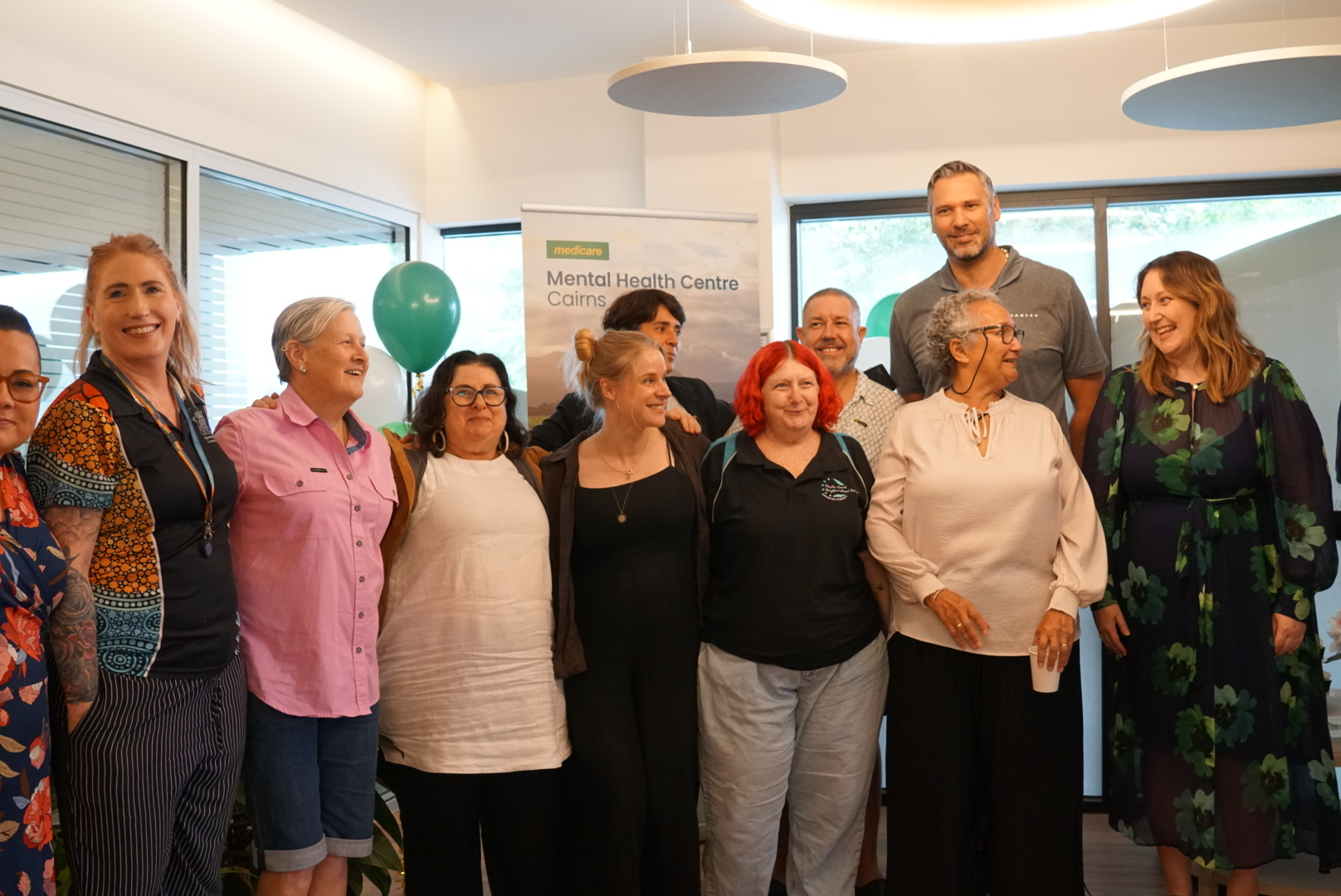
The landscape of healthcare commissioning is undergoing a profound transformation – and it’s being driven by the notion that people who use a service are best equipped to help design it.
With around 130,000 people living with mental illness across northern Queensland, according to the Joint Regional Needs Assessment 2025-2028, many have historically ended up in emergency departments due to gaps in accessible community care.
The new Cairns Medicare Mental Health Centre at 267 Mulgrave Road, Bungalow, aims to change that.
Funded under the National Mental Health and Suicide Prevention Agreement, this free, walk-in service offers immediate, short, and medium-term support without the need for a referral or appointment.
The centre is a landmark partnership between Northern Queensland Primary Health Network (NQPHN), Cairns and Hinterland Hospital and Health Service (CHHHS), and service provider Mind Australia.
Crucially, its very foundation was shaped by the region’s first Lived Experience Advisory Group (LEAG) – a dedicated panel bringing real world insights and living expertise to the project from day one.
The group was embedded into every phase of the centre’s creation, contributing critical insights across service design, culture, and the physical environment.
They shaped delivery models to ensure support is accessible, while advising on architecture and layout to make the building feel safe, calm, and respectful the moment someone walks through the door.
By treating lived experience as a distinct discipline rather than informal feedback, NQPHN and its partners have bridged the gap between how a system is designed on paper and how people in distress experience it.
NQPHN CEO Ben Tooth said everyone deserved access to timely and compassionate mental health support.
“This centre provides a free, walk-in service where people can get help when they need it,” he said.
“Its co-location with specialist CHHHS mental health services creates a more connected system, with smoother step-up and step-down pathways, and ultimately better outcomes for people across the region.”
NQPHN Partnerships and Engagement Specialist Tynan Narywonczyk said the value of this approach lied in the depth of lived expertise.
“Lived experience expertise is built through navigating wobbly life moments, distress, complex systems, stigma, and survival,” he said.
“It is shaped over time through reflection, meaning-making, and understanding what helps and what harms. This is not informal knowledge. It is not secondary. It is different.
“We have a responsibility to ensure that the services we fund are not only grounded in evidence, but connected to the people those services are intended to support.
“This is where lived experience becomes essential. When recognised and embedded properly, lived experience changes how services connect, respond, and support people.
“But this only happens when we stop treating lived experience as something to consult, and start recognising it as something to share power with.”
The insights gathered through LEAG have been so profound that NQPHN has officially transitioned this approach from a project specific engagement model into an embedded, business as usual (BAU) practice.