
Cancer screening programs
National Cancer Screening Register
Access information about your patients’ participation in the National Cervical Screening and National Bowel Cancer Screening Programs through the National Cancer Screening Register (NCSR).
Use the NCSR Healthcare Provider Portal to:
- check a patients’ bowel and cervical screening history
- lodge clinical forms relating to both programs electronically
- order patients a new bowel testing kit.
BreastScreen Australia program
The BreastScreen Australia program is a national free breast cancer screening program. Women, and people with breasts, aged 50 to 74 should be screened every two years.
BreastScreen Australia has launched the Screen with your sistas campaign targeted at increasing the screening rates of Aboriginal and Torres Strait Islander women. In consultation with Aboriginal and Torres Strait Islander women across the country a range of culturally sensitive, purposeful, and meaningful resources have been created.
BreastScreen Australia has also launched the “Screen with your sistas” campaign targeted at increasing the screening rates of Aboriginal and Torres Strait Islander women. In consultation with Aboriginal and Torres Strait Islander women across the country a range of culturally sensitive, purposeful, and meaningful resources have been created.
Useful resources
National Bowel Cancer Screening Program
The National Bowel Cancer Screening Program (NBCSP) aims to reduce deaths from bowel cancer by detecting the early signs of the disease. Eligible Australians complete a free, simple test that is done at home every two years. The program is available to Australians aged 50 to 74 who have been identified from Medicare records.
From 1 July 2024, people aged 45 to 49 can join the program and screen for free by requesting their first free kit be mailed to them. All eligible people aged 45 to 74.
The program now operates two models to help increase screening participation:
- mail-out model – kits are mailed directly to eligible people by the National Cancer Screening Register
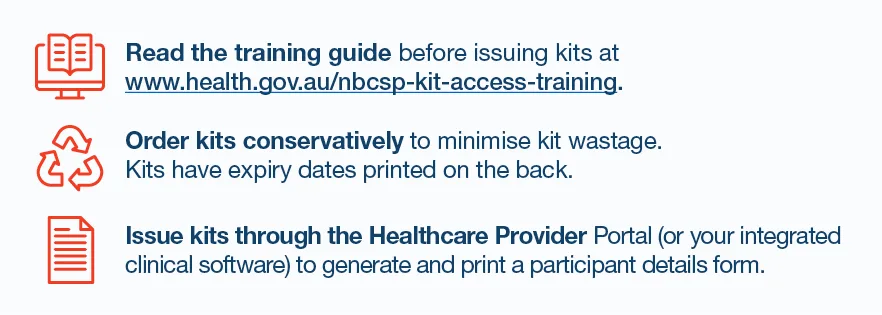
- alternative access to kits model – healthcare providers give kits directly to eligible people, explain why the test is important and demonstrate how to do it.
A hot zone policy exists for hotter areas of Australia, where participants are sent the kit in the cooler months of the year. For participants in hot zones, practitioners can still give them a kit if they see a clinical benefit.
The National Bowel Cancer Screening Program is a Commonwealth Department of Health and Aged Care program and is supported by the National Cancer Screening Register.

Useful resources
- Access kits for your patients
- Alternative access to bowel screening kits training guide
- Bowel cancer screening resources
- Checklist for talking with your patient about doing a bowel screening test
- Clinical practice guidelines for the prevention, early detection, and management of colorectal cancer
- Closing the gap with bowel cancer screening
- NBCSP clinical resources
- NBCSP translated resources
- Supporting Indigenous patients
National Cervical Screening Program
The National Cervical Screening Program (NCSP) aims to reduce illness and death from cervical cancer. Women and people with a cervix aged 25 to 74 years of age are invited to have a Cervical Screening Test every five years.
Self-collection
You may be more familiar with the term Pap smear. But the cervical screening test has replaced this and is more effective, with a cervical screening self-collection option now available to eligible participants.
Self-collection allows patients to take their own vaginal sample for HPV testing, offering a more accessible and equally effective method for detecting potential issues such as CIN2+, adenocarcinoma in situ, and oncogenic HPV compared to the conventional clinician-administered test. For more information about self-collection, visit the Australian Centre for the Prevention of Cervical Cancer’s (ACPCC’s) FAQ on self-collection or the Australian Government Department of Health and Aged Care’s page on self-collection.
To address inequity and additional barriers to screening, two new self-collection campaigns have been launched: Own It and Screen Me. The ‘Own It’ campaign aims to promote patient choice in cervical screening, particularly the option of HPV self-collection for women and people with a cervix who are Aboriginal and/or Torres Strait Islander, multicultural, LGBTQIA+, or living in regional or remote areas. The Screen Me campaign is designed for women and people with a cervix living with a disability.
Useful resources
- ACPCC clinical resources
- ACPCC education and courses
- ACPCC self-collection for health professionals
- Cervical Cancer Screening Guidelines
- Cervical screening information for health professionals
- Cervical screening and self-collection: healthcare provider resource hub
- Cervical screening resources for health professionals
- National Cervical Screening Program course bundle
- National Strategy for the Elimination of Cervical Cancer in Australia
- Own It! Cervical screening toolkits for healthcare providers
National Lung Cancer Screening Program
Delivering the National Lung Cancer Screening Program
The National Lung Cancer Screening Program (NLCSP) is now available, allowing eligible Australians aged 50-70 with no signs or symptoms of lung cancer to screen in the program every two years.
Lung cancer is Australia’s leading cause of cancer death. This program aims to improve health outcomes for Australians by increasing early detection of lung cancer and saving lives.
Make sure you are ready to deliver the program
Healthcare providers and the health support workforce play a central role in the NLCSP by assessing participant eligibility, referring eligible participants, and supporting participants through the screening and assessment pathway.
To support you in delivering the program, education, and resources are available for healthcare providers. You can access the resources on the Australian Department of Health Disability and Ageing website.
To make sure you feel ready, you should:
- familiarise yourself with the Program Guidelines
- complete the relevant online education
- download or order program resources
- register and integrate your practice with the National Cancer Screening Register.
Lung cancer screening can detect up to 70 per cent of lung cancers in the early stages and could help save hundreds of lives each year.
Developed by the Australian Government, in partnership with the National Aboriginal Community Controlled Health Organisation, this program is designed to be equity-focused, culturally safe, and person-centered
Find out more about the program and access information and resources for the health workforce at health.gov.au/nlcsp-hcp-toolkit
Useful resources
- Delivering the National Lung Cancer Screening Program – Guideline
- Getting ready for the National Lung Cancer Screening Program – Factsheet
- Lung cancer screening information for First Nations people
- National Lung Cancer Screening Program – Communications toolkit
- National Lung Cancer Screening Program – Poster
- National Lung Cancer Screening Program – Healthcare provider toolkit
- National Lung Cancer Screening Program – Webinar Q&A
National Cancer Screening Program - Updates
National Cancer Screening Programs update – June 2025: New resources for integrating with the NCSR and preparing for the National Lung Cancer Screening Program